

Work Guaranteed
Same Day Service
Established in 2009
Certified Engineers
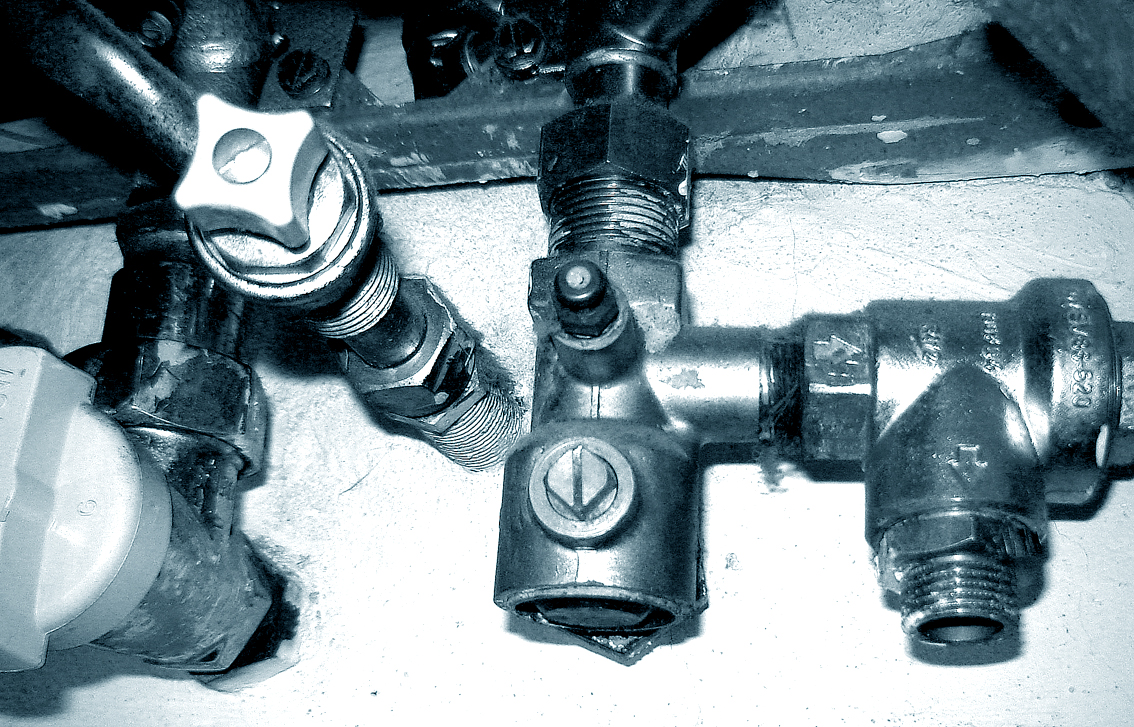

A leaking boiler is not something that can be ignored as if left to develop further it could not only cause a lot of damage but become a serious health hazard. When spotted and dealt with quickly by a qualified Gas Safe engineer it will save you a lot of money and stress.
There are a number of reasons why a leak may develop in boiler, ranging from poor installation to age deterioration or too much pressure in the system. Whatever the reason for the leak the most important thing is to have your boiler repaired as soon as possible. We’ve put together a guide on how to identify a leak and what you can do next.
If your boiler keeps cutting out due to low pressure, this could be because you have a leak that hasn’t yet been noticed. Sometimes you may see a boiler leaking water on the surface or wall below. Smaller leaks can also reveal themselves as a stain or mould close by to the boiler, or with warped skirting boards.
A boiler dripping from the bottom of the unit could be due to a faulty heat exchanger, or an internal leak yet to be identified. If you notice water coming out of a boiler you will need to contact an experienced company who can quickly attend your property to resolve the issue. Central heating is a sealed system, so the real risks of ignoring a leak are the boiler locking out, corrosion, and water damage to ceilings and floorboards.
When a boiler is operating correctly you should not see any water leaking from the system. If you do, it could be because:
It is often the case that a leak can be fixed without the need for a new boiler, although this depends on the type and extent of leak that occurs.
Customers often ask: “My boiler is leaking water from the bottom, what can I do?” This could be caused by a leak from the heating pump, a faulty pressure release valve, heat exchanger corrosion or issue with the auto-air vent.
A boiler condensate pipe dripping could be due to a cracked heat exchanger. This can lead to mains water or the system draining into the condensate pipe and the hot water can cause the pipe joints fail. Installing a new heat exchanger should resolve this.
Water dripping from the copper pressure relief discharge pipe (PRV pipe) on a combi boiler is usually because there is too much pressure in the system, or the valve is not sealed correctly. A Gas Safe engineer can diagnose and fix a Combi boiler leaking in this way.
This is common on budget or older boiler models. However, it isn’t something you will be able to diagnose yourself, so you will need a professional engineer to come and identify the issue.
A leaking heat exchanger could mean the end for a boiler, although there are occasions where it can be replaced. In many cases, it is more cost-effective to buy a new boiler instead.
Boilers start to struggle when they experience too much pressure, which leads to them breaking down. Check the pressure gauge on the boiler. If the needle is above the green band (usually over 2.5 bar with the heating off), the pressure is too high.
The easiest way to bring high pressure down is to bleed a radiator. Switch the heating off first and wait until the radiators are stone cold. Bleeding a hot, pressurised system risks scalding. Make sure the filling loop taps under the boiler are closed, then open the bleed valve with a radiator key, holding a cloth or small container underneath. Letting air out alone will not lower the pressure much: you need to let some water out too. Close the valve and check the gauge as you go, until it reads between 1 and 1.5 bar.
Corrosion of the pipes under the boiler is a common reason for a boiler leak. Sometimes it can also be due to poor installation, although the former is a more common occurrence. Check the pipes and if any are wet or leaking, if so, then this is the source of the problem.
A qualified gas engineer will have to be called out to fix leaking boiler pipes. But you can help contain the water in the meantime by placing a bowl underneath to capture it so it doesn’t run across the surface below.
Some leaks can be easier to identify than others. Internal boiler leaks on joints and parts such as seals can be a result of decay due to sustained pressure on the system. When seals are broken, water can start to come out quite rapidly.
Never remove the boiler casing yourself – only a Gas Safe registered engineer should open the boiler. An engineer will be able to spot this kind of leak very quickly. It’s usually relatively easy to fix and seals do not cost a lot of money to replace.
You won’t necessarily know that the leak is being caused by poor installation – unless you are a qualified engineer. However, boiler pipes leaking can be a tell-tale sign that the boiler may not have been installed up to the required standard.
This will be something that only a qualified Gas Safe engineer will be able to fix. It may be the case that a new boiler installation is required to rectify the existing issues. This may be more costly than you hoped, but it will ensure you and your family are safe.
Whenever you spot or believe a leak is occurring within your boiler you should contact an experienced Gas Safe engineer. No matter how small it may appear to be, the leak can eventually lead to extensive damage occurring not only to the boiler but to your property too.
Often, leaks do have fairly straight forward fixes and many people will feel comfortable bleeding a radiator. However, if the diagnosis of what’s causing the leak is incorrect, the attempted fix could make things worse. If in any doubt at all, please do contact either the company that installed your boiler system or experienced Gas Safe engineers like ourselves.
Error codes: A1, E9, CE207 and H07
These error codes will typically appear on models such as Worcester CDi Highflow, Worcester Greenstar 25i, Worcester CDi Classic, Worcester Greenstar 30i and almost all Worcester boilers.
Error codes: F.13, F.22, F.24, F.73, S.41 and S.53
These error codes will be seen on Vaillant EcoTEC Pro, Vaillant EcoMax Pro and Vaillant EcoTEC Plus models.
Error codes: 117, 118, 125, E78, H.02, H.03, H.04, H.05, H.06
These error codes will appear on Baxi 200 / 400 Combi Gas boilers.
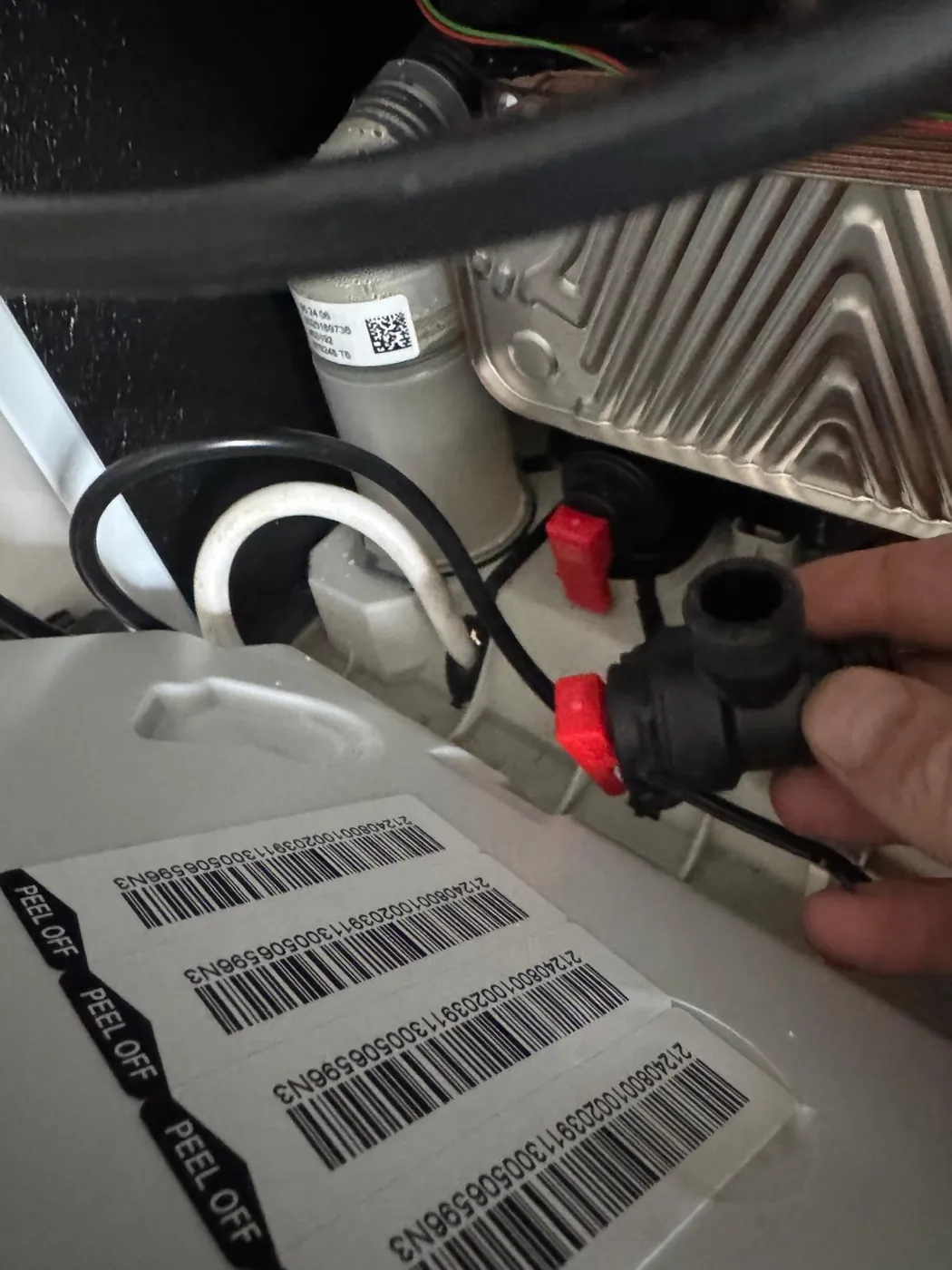
When we attend a leaking boiler, the engineer checks the pressure relief valve and its pipe, the seals and joints on the pump and pipework, the heat exchanger, the expansion vessel and the automatic air vent. Only a Gas Safe registered engineer should open the boiler to do this.
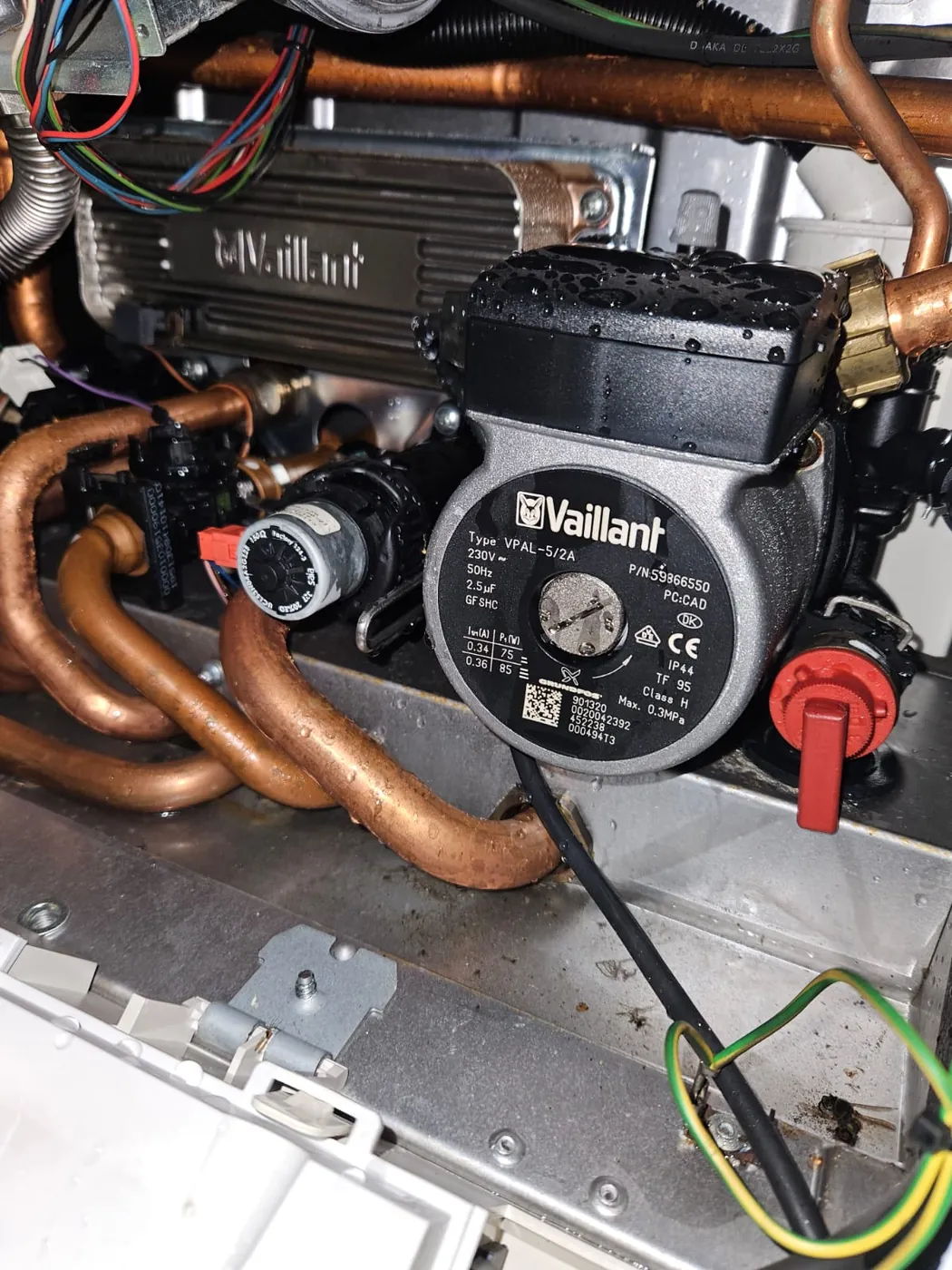
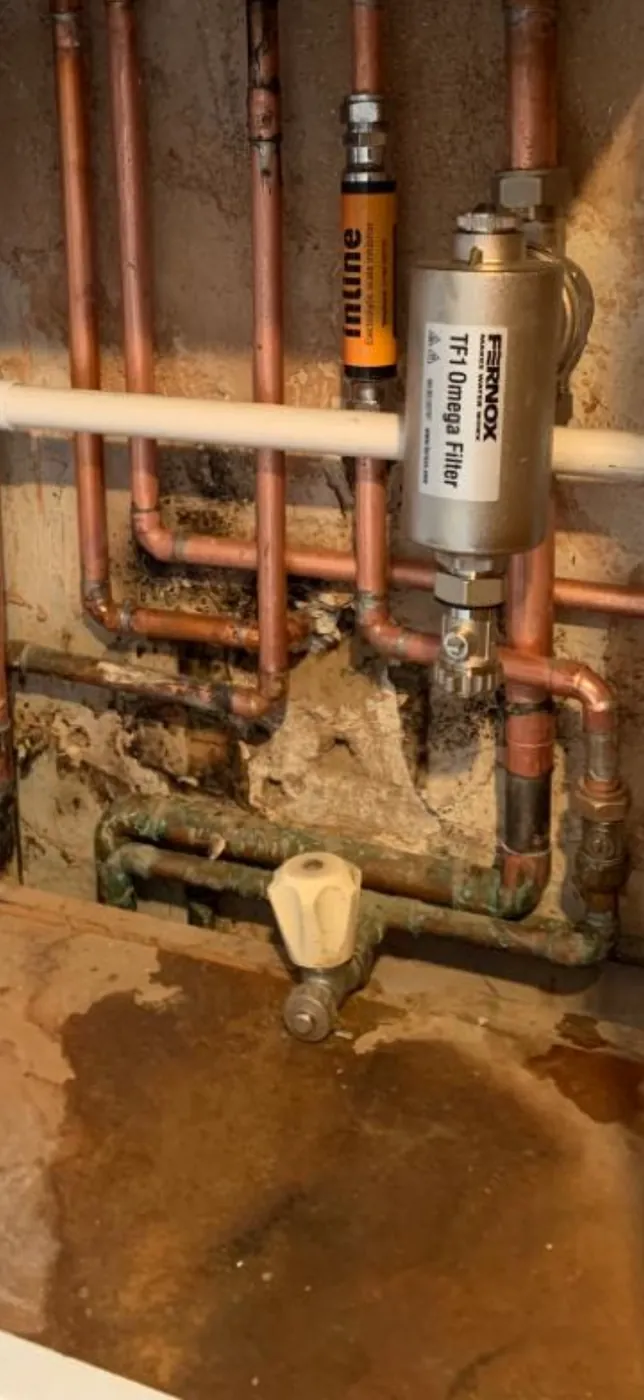
From the job: a combi dripping from the pressure relief pipe
Viessmann Vitodens combi reaching nearly 3 bar with the heating on, and water dripping from the pressure relief pipe outside. The expansion vessel was flat. Drained the boiler, recharged the vessel to 1 bar and refilled. Now stays well under 2 bar when hot.
Expert notes by Kevin Saban, Gas Safe registered engineer (Gas Safe ID 6115119), Homecure Plumbers – Gas Safe Reg 505421
Repairs from £95 + VAT for the first hour, including diagnosis (or a fix if it can be done within the first hour with no parts needed), no callout charge. Typical costs, including parts and labour, fitted:
| Repair | Typical cost |
|---|---|
| Pressure relief valve replacement | from £176 + VAT |
| Leak repairs on heating pipework, including seals and joints | from £196 + VAT |
| Expansion vessel recharge | from £95 + VAT |
| Expansion vessel replacement | from £214 + VAT |
| Boiler pump replacement | from £289 + VAT |
| DHW (plate) heat exchanger replacement, the part that heats your hot water | from £277 + VAT |
| Main heat exchanger replacement | Price on request, as it varies widely by boiler |
Subject to diagnosis; prices vary depending on boiler model and job complexity. For pipework leak repairs, prices vary depending on the job and access. Prices apply during office hours; parking or the congestion charge may be added.
Book a same-day visit: 0203 504 4000
By design, a boiler should never leak gas or oil. If you see dripping oil or suspect there may be a gas leak it must always be treated as an emergency. If you smell gas, turn off the gas at the meter control valve, get outside and call the National Gas Emergency Service on 0800 111 999. Carbon monoxide is different: it has no smell, which is why it’s important to install a carbon monoxide detector nearby (landlords must install these by law in their rented properties). The intake of too much carbon monoxide can prove lethal.
If you start feeling sick, tired, dizzy or develop a headache near a gas appliance, it could be carbon monoxide. Stop using the appliance if you can, open the windows, leave the property and call 0800 111 999, then get medical advice. The NHS lists the symptoms of carbon monoxide poisoning.
When it comes to leaking oil the smell may alert you to the problem and you may also spot stains or pooling on nearby surfaces. If this happens, close the tank’s tap or valve, open all the windows and place a container beneath the leak to prevent it from spreading.
Do not call us to deal with an active gas escape: that is a job for the National Gas Emergency Service. Once the supply has been confirmed safe or capped, Homecure can attend to repair or replace the appliance. For an oil leak, get in touch with us right away. We provide a range of boiler services including leak detection in London.
Many customers ask “Is a leaking boiler an emergency?” and as qualified Gas Safe engineers, it is an issue we believe needs to be addressed as quickly as possible. It can significantly damage the boiler and your home, leading to rust and mould which can then spread.
If you see water dripping from boiler parts it will eventually lead to low water pressure. This will also affect your central heating, as the performance levels will be reduced and it will have to work much harder to heat the space.
Another common question we hear is: “If my boiler is leaking can I still use it?” If you see a leak or notice the boiler pressure has dropped quite a lot then avoid using the boiler. Switch off the water supply and central heating and call the Homecure team as soon as possible.
Water dripping from the copper pressure relief discharge pipe (PRV pipe) could be because too much pressure has built up in the system due to a failed expansion vessel. You will need to call out a qualified Gas Safe engineer as soon as possible to have this fixed.
If a boiler is leaking carbon monoxide the flame will be yellow instead of blue. Condensation can also build on windows and/or staining around gas appliances. A boiler gas leak is extremely dangerous so in this instance turn off the boiler, open windows, leave the property and call the National Gas Emergency Service on 0800 111 999 immediately.